

Price range: $29.95 through $37.95
Select options
This product has multiple variants. The options may be chosen on the product page
Substorm Phase: Quiet; Aurora Activity Score: 7/100
Denver sits around 40 degrees north, well south of the band where the aurora lives on an ordinary night, so most evenings the show stays locked over Alaska and northern Canada. But the lights reach this far south more often than most people think. When a strong geomagnetic storm slams into Earth, it shoves the auroral oval hundreds of miles south, dragging the glow down over Wyoming and Nebraska until Denver's northern horizon starts to light up. The historic storms of 2024 proved it, and with the sun in an active stretch of its cycle, these nights keep coming around. The catch is timing, because the windows open fast and close fast, and the people who catch them are simply the ones already watching. That is the whole job of this page.
We refresh tonight's Denver forecast around the clock from live solar wind data, read straight off NOAA's monitoring satellites parked far upstream of Earth where the wind shows up before it ever reaches us. You get a straight answer on what the sky is doing, not a vague “aurora possible” shrug. We tell you whether tonight leans toward a faint glow your camera will pull out of a long exposure or a brighter show your own eyes can follow low on the northern horizon. Watch it unfold in real time on our minute-by-minute forecast.
Tomorrow night's outlook looks further ahead, tracking any solar eruption already on its way and the storm it might deliver. That head start matters in Denver, where the darkest skies sit thirty to ninety minutes from the city and Front Range weather can slam the window shut fast. Our 3-day forecast covers the next 72 hours and the 45-day outlook looks even further, so you can plan the drive, scout your horizon, and clear your night before conditions peak instead of scrambling once they do.
Denver sits well south of the usual aurora zone, but not beyond its reach. The sun is moving through the most active stretch of its eleven-year cycle, which means more storms, more often, reaching further south than they have in years. During the biggest storms, people across the Front Range have stood out on the plains and watched green and even deep red curtains ripple above the northern horizon with the naked eye. Those nights are not a fantasy. They are a forecast away, and they are happening more now than they have in a long time.
The aurora rides low on the northern horizon, so a flat, dark northern view beats elevation every single time. Forget the high peaks. The spots below run from the always-open eastern plains to the foothill edges out west, all within about 45 minutes of central Denver, and most work just as well from Boulder. One heads-up before you go, several metro parks gate their lots in the evening, so the closing times matter as much as the views. For the darkest skies of all, the northeast plains around Pawnee reward a longer drive, and our Colorado aurora guide covers them in full.
| Spot | Horizon | Drive from Denver | Why Go |
|---|---|---|---|
| The Eastern Plains (Watkins / Bennett) | Flat, dark, wide open north | About 35 min | The darkest sky that stays open all night |
| Barr Lake State Park | Cleanest park horizon, plus water | About 30 min | Best metro horizon, but a 10 PM gate |
| Rocky Flats pull-offs | Elevated, open north, Flatirons backdrop | About 25 min | Public road pull-offs, no gate |
| Daniels Park | High, open mesa | About 40 min | Dark southern vantage over the metro |
| Red Rocks Upper North Lot | Decent, with metro glow | About 30 min | Easy and seated, with caveats |
About 35 minutes east and the most reliable pick for the deep-night hours, since these public roads never close. Take I-70 to the Watkins or Bennett exit, then head a few miles north onto the county grid roads to drop the interstate glow behind you. The horizon out there is dead flat and pitch black all the way to the Wyoming line.
About 30 minutes northeast, with the cleanest northern horizon of any park option and water that can throw a double-show reflection when the aurora climbs high.
Insider tip. The gate closes at 10 PM unless you are actively fishing, so treat this as an early-evening spot rather than an all-nighter.
Sitting between Broomfield and Boulder with the Flatirons as a backdrop. The wildlife refuge trails close at sunset, so skip the gates and use the public gravel pull-offs along Highway 128 and the Interlocken loop, which give you an elevated, unobstructed view straight north.
About 40 minutes south near Sedalia, a high, open mesa with a wide sweep north back over the metro. It stays remarkably dark for how close it sits to the southern suburbs.
Insider tip. It is a Denver Mountain Park, so check the posted closing time before you settle in for the late hours.
About 30 minutes west and the easy, seated choice, with the trade-off of more ambient light from the metro. Park in the Upper North Lot, since the main monoliths block the northern horizon from the amphitheatre itself.
Insider tip. Check the Red Rocks event calendar first, because the park closes to non-ticket holders on concert nights, and rangers clear the lots about an hour after sunset on quiet ones.
Northern Hemisphere
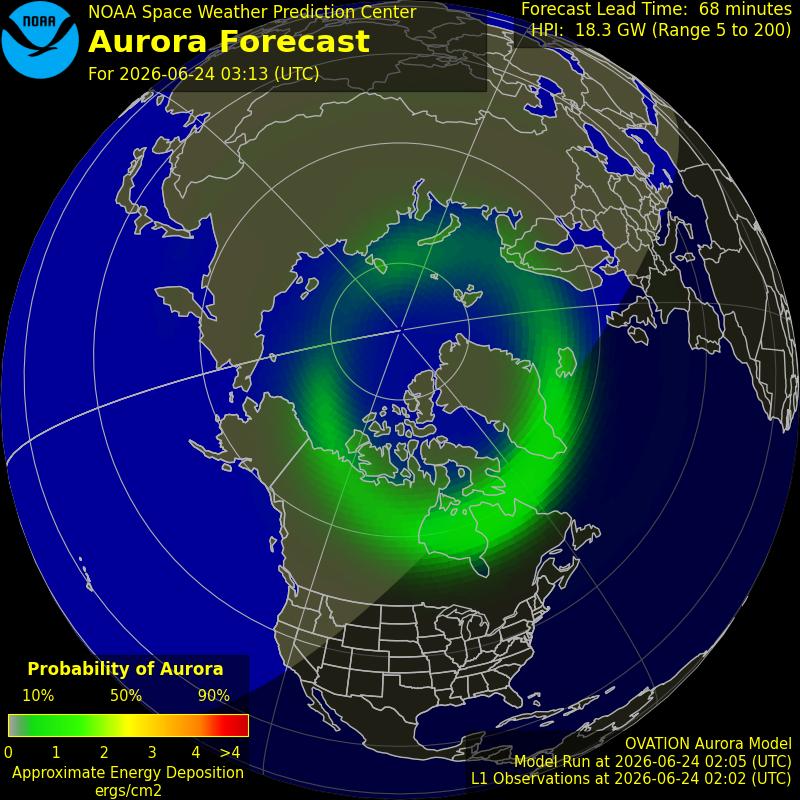
Most aurora apps boil the whole sky down to one index number built for scientists comparing global activity in three-hour blocks. It was never meant to tell a chaser in Denver whether tonight is worth the drive, so we threw it out.
We track more than 50 live measurements instead. The one that matters most for Denver is hemispheric power, the raw energy pouring into the auroral oval right now. Around 80 gigawatts is the floor for a real shot here, and 90 or higher is when the odds climb fast. We also watch the solar wind, its speed, its density, and which way its magnetic field points, and we refresh all of it every few minutes, because a quiet sky can wake up in a hurry.
Price range: $29.95 through $37.95


Price range: $33.95 through $40.95

Price range: $38.95 through $44.95
Skip the high passes. The aurora rides low on the northern horizon, so peaks to the north block the exact slice of sky you need. For aurora specifically, the flat eastern plains beat the foothills every time.
Stay in town in a pinch. When a show pops without warning, City Park and Sloan's Lake give you a quick north-facing view inside the metro while you decide whether to make the drive.
Scout in daylight. The county roads east of Watkins and Bennett are unlit and easy to lose in the dark. Drive them once in daylight to pick your foreground, learn the turns, and find your exits before nightfall.
Mind the gates. Most metro parks lock their lots between sunset and 10 PM, so the always-open county roads on the plains are your safest bet for the late hours.
Alert first, drive second. Denver shows are brief and easy to miss, so a live alert the moment a storm fires matters more than any single spot on this list. Let the alert make the call. That is exactly what we built.
Know the season. Your best months run September through April, with the strongest odds in March and April and again in September and October. Activity peaks between 10 PM and 2 AM, and the window near midnight tends to deliver the most.
Real late-night coffee is scarce in the metro. These two are worth knowing before the long drive out.
The Bardo Coffee House, Denver. Open until midnight daily on South Broadway and on West 38th in Wheat Ridge. The true late-night option, and a solid place to watch live solar wind while you wait out twilight. The Wheat Ridge spot sits right on the way if you are heading northwest toward Boulder or the foothills.
Hudson Hill, Denver. In Capitol Hill, pulling top-tier specialty coffee until 11 PM most nights and 12:30 AM on Friday and Saturday. It doubles as a cocktail bar, but a proper espresso at 11 PM is no trouble before you point the car at the plains.
Denver's aurora is a rare treat. When you want a show that is all but guaranteed, these three destinations sit right under the auroral oval, where the lights appear on most clear nights. We keep a full forecast guide for each.

Frequent aurora paired with waterfalls, black-sand beaches, and hot springs, which makes it the classic bucket-list chase. See the Iceland forecast.

One of the best aurora spots on Earth, sitting right under the oval on the shore of Hudson Bay, with polar bears as a bonus in the fall. See the Churchill forecast.

High in the Arctic above the Norwegian fjords, Tromso delivers reliable winter displays with a lively town as your base camp. See the Tromso forecast.
The Denver aurora gives no warning. A storm can flare for twenty minutes and fade before you think to look up, and no amount of staring at your phone changes that. So our alerts fire the moment conditions spike, not on a timer. The text lands even on the weak signal out past Barr Lake and the eastern plains, the same dead zones where the data-hungry apps go dark and the darkest skies happen to wait. Keep your phone by the bed. We will wake you when it is real.
Yes, you can see the northern lights in Denver, though it takes a strong geomagnetic storm to drag the aurora far enough south to reach the metro. Your best odds come from a dark site on the eastern plains with a flat, open view to the north. During the biggest storms, like those in 2024, people across the Front Range watched green and even red light ripple above the horizon with the naked eye.
The best time to see the northern lights in Denver is September through April, when the nights run long and dark. The strongest odds land in March, April, September, and October, and activity peaks between 10 PM and 2 AM. A dark, moonless night well away from the city glow gives you the clearest view.
The best place to watch the aurora near Denver is the eastern plains around Watkins and Bennett, where public county roads stay open all night under a flat, pitch-black northern horizon. Barr Lake State Park has the cleanest northern horizon of the metro parks, though its gate closes at 10 PM. For the darkest skies of all, the northeast plains around Pawnee reward a longer drive.
Aurora Admin's Denver forecast works by reading the live machinery of a geomagnetic storm, not a single index number. We track hemispheric power, solar wind speed and density, and the direction of the solar wind's magnetic field, all straight from NOAA satellites, and refresh the read for Denver every few minutes. Around 80 gigawatts of hemispheric power is the floor for a real shot here, and 90 or higher is when the odds climb fast.
Aurora Admin sends SMS alerts instead of relying on an app because the aurora is brief, sudden, and impossible to time to the minute. A text reaches your phone even on a weak signal out on the plains, where app notifications that need a strong data connection fail. The alert fires the moment conditions spike, so you can sleep until the sky is worth chasing.
Aurora Admin gives you honest, Denver-specific northern lights forecasting, built by chasers who have spent countless cold nights learning exactly what these skies do. No hype. No useless single number. Just a clear read on tonight and a text the moment the aurora is on its way. Sign up for alerts and let us be the friend who wakes you when it counts.
Less than a latte. Way better than missing the lights!
Everything you need to catch the auroras at your location.
Less than a fast food meal. Never miss a display.
Lock in your alerts for a full aurora season and save.