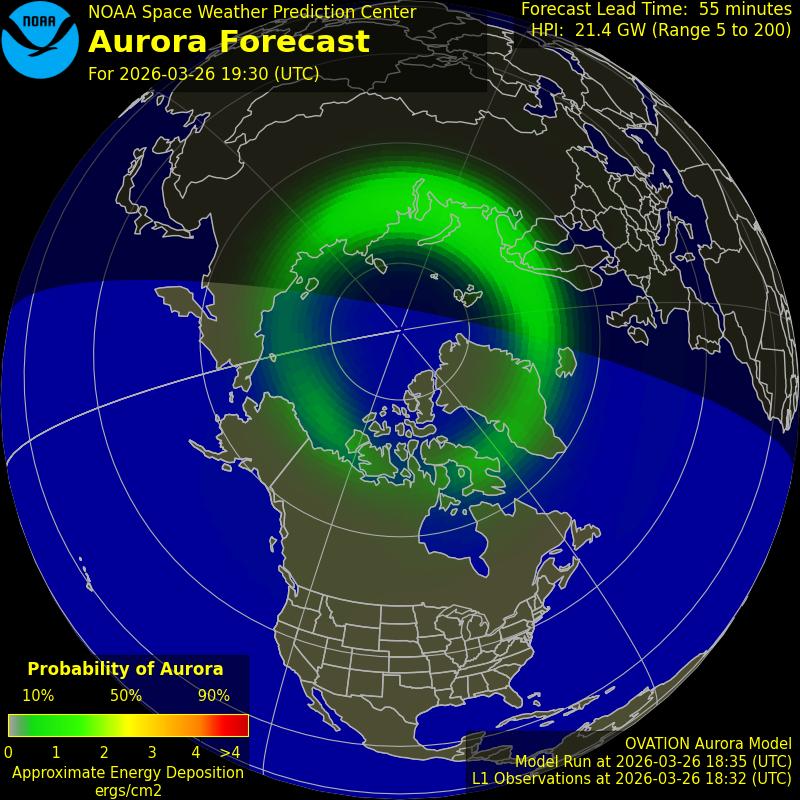
Welcome to the Northern Lights Forecast page for Banff, where the mystical dance of the Aurora Borealis meets the breathtaking landscapes of Banff National Park. Our real-time Aurora Borealis forecast provides you with the latest insights into when and where you can experience this mesmerizing celestial phenomenon in the heart of the Canadian Rockies. Whether you're a seasoned aurora chaser or a first-time observer, this page will guide you through the optimal times and locations to witness the awe-inspiring Northern Lights in Banff's pristine night skies.
How to use this data:
If you're excited to witness the enchanting Northern Lights in Banff, our tool serves as an invaluable resource for predicting aurora appearances. We gather live satellite data and present it in an easily navigable dashboard, eliminating irrelevant information. While interpreting the data might seem complex, our comprehensive “how-to” guide offers clarity.
Utilize our long-range forecast to meticulously plan your aurora-chasing escapade well ahead of time, and augment your experience with real-time minute-to-minute insights, ensuring an enriched journey through the mesmerizing night skies of Banff.
Where to See the Northern Lights in Banff?
Banff National Park offers a stunning backdrop for witnessing the Northern Lights. Here are some prime locations within the park where you can experience the magic of the auroras:
Lake Minnewanka: Head to Lake Minnewanka, one of Banff's largest lakes, for unobstructed views of the night sky. The calm waters reflect the dancing lights, creating a surreal ambiance.
Vermilion Lakes: These serene lakes, located just outside Banff town, provide an excellent vantage point for observing the Northern Lights with the iconic Mount Rundle in the background.
Bow Lake: This glacial lake, situated on the Icefields Parkway, offers minimal light pollution and expansive views of the sky, making it an ideal spot for aurora hunting.
Moraine Lake: Although access might be limited in the winter months, if you get the chance, the reflection of the Northern Lights on the turquoise waters of Moraine Lake is a sight to behold.
Castle Junction: Just a short drive from Banff town, Castle Junction provides a relatively dark area for stargazing and Northern Lights viewing.
Peyto Lake: While the road to Peyto Lake is closed in the winter, consider visiting during the fall or spring for captivating views of the auroras over this iconic glacial lake.
Remember, the Northern Lights are a natural phenomenon, and their visibility is influenced by solar activity and weather conditions. To enhance your chances of witnessing this celestial display, choose clear nights, dress warmly, and keep an eye on real-time aurora forecasts. Explore these Banff locations for an unforgettable encounter with the captivating Northern Lights.
When Can You See the Northern Lights in Banff?
Typically, the Northern Lights become visible after nightfall, usually from around 11:00 PM to 3:00 AM the following morning. However, on particularly intense nights, the auroras have been known to appear even earlier.
When is the best time of year to see the aurora borealis in Banff?
The best time to witness the Northern Lights in Banff is during the fall, winter, and early spring months, from September to April. These months offer longer nights and darker skies, providing optimal conditions for observing the mesmerizing auroras as they dance across the celestial canvas.
To increase your chances of catching this breathtaking natural spectacle, keep an eye on real-time aurora forecasts. These forecasts consider solar activity and geomagnetic conditions, helping you plan your aurora-chasing adventures during periods of heightened auroral activity.
While the Northern Lights are a mesmerizing phenomenon, they can be elusive and influenced by various factors. Choose clear nights, venture away from city lights to reduce light pollution, and consider heading to one of Banff's prime viewing locations for an enhanced experience under the radiant Northern Lights.
Can you see the northern lights in Banff tonight?
The possibility of witnessing the Northern Lights in Calgary tonight hinges on the incoming data. For the most precise updates, closely monitor Aurora Admin and follow the incoming data. If the specific criteria align, there is a favorable chance of experiencing the awe-inspiring aurora borealis.
How long do the Northern Lights usually last?
The duration of the Northern Lights, scientifically known as the aurora borealis, can vary. On average, a single display of the Northern Lights may last anywhere from a few minutes to several hours. However, during periods of heightened solar activity and favorable conditions, the auroras can persist for several hours, providing a mesmerizing spectacle in the night sky. The exact duration of the auroras depends on factors such as the intensity of the solar storm, atmospheric conditions, and the strength of the aurora display. Keep in mind that while some auroras are brief, others can offer an extended and breathtaking show.
What to Expect from the Northern Lights:
When witnessing the captivating Northern Lights, anticipate a display of dazzling colors painting the night sky. However, it's essential to note that the naked eye may perceive the auroras differently than a camera sensor, which is more sensitive. While photographs often capture vibrant shades of green, pink, and purple, the human eye might discern more subtle hues. Be prepared to witness beautiful white flashes or flickering, which can sometimes resemble clouds. To capture the true brilliance of the auroras' vibrant colors, consider using long exposures with a camera. Remember that the enchanting dance of the Northern Lights is a unique and awe-inspiring spectacle, offering a breathtaking experience that may not perfectly match the colors seen in photographs.