
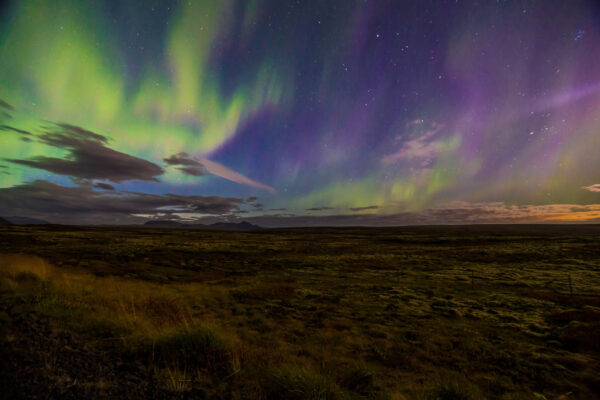
The world's polar regions are home to one of the most enchanting and awe-inspiring natural phenomena known as the Northern Lights (Aurora Borealis) and its counterpart, the Southern Lights (Aurora Australis). These dazzling displays of vibrant colors streaking across the night sky have captured the imaginations of people for centuries. However, while these celestial light shows have been observed and admired by countless individuals, the mechanisms behind their creation have remained somewhat mysterious.
The Pivotal Role of Coronal Mass Ejections (CMEs)
In recent years, significant progress has been made in unraveling the mysteries of these luminous displays. Scientists have uncovered a strong connection between the occurrence of the Northern and Southern Lights and a remarkable solar phenomenon known as Coronal Mass Ejections, or CMEs for short. These gigantic bursts of solar wind and magnetic fields released by the Sun play a pivotal role in shaping the Earth's auroras, transforming the night sky into a canvas of dancing lights.
Preview of the Article's Content
This article embarks on a journey through the cosmos to explore the formation of Coronal Mass Ejections, or CMEs, from their origin on the Sun's surface to their interaction with Earth's magnetosphere. We will delve into the intricate processes that lead to these solar eruptions and their far-reaching impacts, including the mesmerizing displays of the Northern and Southern Lights.
Through this exploration, you will gain a deeper understanding of how CMEs are born, how they travel through space, and the remarkable effects they have on our planet's magnetic field. We will also discuss how these celestial events influence the appearance and intensity of the Northern and Southern Lights, creating the breathtaking displays that have fascinated skywatchers and scientists alike.
So, fasten your seatbelts and prepare to journey into the heart of the Sun, where the story of Coronal Mass Ejections begins, and discover their profound influence on the dazzling spectacle of auroras that grace our polar skies.
Understanding Coronal Mass Ejections (CMEs)
Coronal Mass Ejections, commonly referred to as CMEs, are colossal bursts of solar material and magnetic energy that are ejected from the Sun's corona into space. These events are characterized by their immense size and energy, making them one of the most powerful phenomena in our solar system. CMEs consist of charged particles, primarily electrons and protons, embedded within a magnetic field.
CMEs can vary in size and shape, but they typically form a massive, expanding cloud of solar material that can reach speeds of up to several million miles per hour. The most distinguishing feature of a CME is its capacity to release an enormous amount of energy and matter into the solar system, affecting everything in its path, including Earth.
The Sun's Role in Producing CMEs
CMEs originate from the Sun, primarily within its outermost layer, the corona. The corona is an extremely hot and tenuous region of the Sun's atmosphere, and it is where the Sun's magnetic field lines become twisted and distorted due to the Sun's complex and dynamic nature.
The exact mechanism that triggers CMEs is not yet fully understood, but it is believed to be associated with the Sun's magnetic field. The Sun's magnetic field is created by the movement of charged particles within its core. As these particles circulate, they generate magnetic fields that extend outward into space. Over time, the magnetic field lines can become twisted and stressed, eventually reaching a point where they release their pent-up energy explosively, resulting in a CME.
Solar Flares vs. CMEs: Key Differences
While both solar flares and CMEs are solar phenomena, they are distinct events with unique characteristics. Solar flares are sudden, intense bursts of electromagnetic radiation across the electromagnetic spectrum, from X-rays to radio waves. They are primarily associated with the release of magnetic energy in the Sun's atmosphere and are often accompanied by a brief increase in brightness.
In contrast, CMEs involve the expulsion of solar material into space, primarily composed of charged particles and magnetic fields. While solar flares and CMEs can occur simultaneously, they are not one and the same. CMEs are known for their ability to deliver a massive payload of solar material into the solar system, affecting the space environment and potentially impacting Earth's magnetosphere.
Frequency and Occurrence of CMEs
CMEs are relatively common solar events, but their frequency can vary based on the Sun's activity cycle. The Sun goes through an approximately 11-year cycle known as the solar cycle, which is characterized by periods of increased and decreased solar activity. During the solar maximum, which occurs roughly every 11 years, CMEs and other solar events become more frequent and intense.
While CMEs are frequent during solar maximum, they can occur at any time during the solar cycle. Scientists continuously monitor the Sun's surface for signs of CME activity, and with advanced space-based observatories, they can provide warnings and forecasts when a CME is directed towards Earth. These forecasts are crucial for space weather prediction and protecting our technological infrastructure from the potential effects of CMEs.
In the following sections, we will explore the journey of CMEs from their birth on the Sun to their interactions with Earth, shedding light on the captivating relationship between these solar phenomena and the mesmerizing auroras they produce.
Formation of Coronal Mass Ejections
The Sun's Magnetic Field
-
Overview of Solar Magnetism
To understand the formation of Coronal Mass Ejections (CMEs), we must first delve into the intricate world of solar magnetism. The Sun's magnetic field plays a pivotal role in governing the Sun's behavior and the occurrence of solar events. Unlike Earth's relatively simple dipole magnetic field, the Sun's magnetic field is complex and dynamic.
The Sun's magnetic field is generated by the movement of charged particles within its core. This movement generates electric currents, which, in turn, generate magnetic fields. These magnetic fields extend from the Sun's interior to its outer atmosphere, the corona. The complex interaction of these magnetic fields creates the foundation for CME formation.
-
Magnetic Field Lines and Loops
The Sun's magnetic field lines are not fixed but are in a constant state of motion and change. They create a dynamic environment within the solar atmosphere. Magnetic loops, a common feature on the Sun's surface, form when magnetic field lines emerge from the Sun's surface, arch into the corona, and then return to the surface. These loops play a crucial role in solar eruptions and CMEs.

B. Solar Eruptions
-
Formation of Solar Flares
Solar flares are often the precursors to CMEs. They occur when magnetic energy stored in the Sun's atmosphere is suddenly released. This release results in a burst of energy across the electromagnetic spectrum, from X-rays to radio waves. The process begins when magnetic field lines become twisted and stressed, causing them to reconnect or reconfigure.
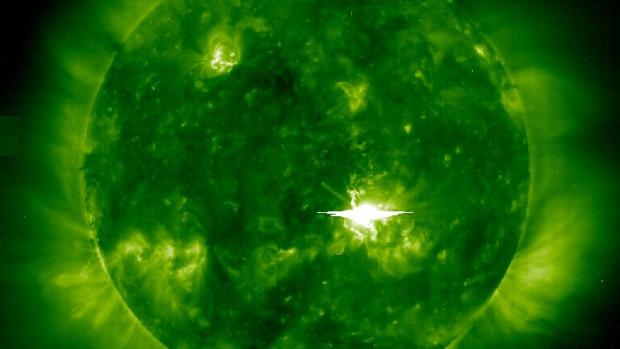
Source: NOAA
A photograph of a solar flare. The bright white spot shows a flare. -
Role of Magnetic Reconnection
Magnetic reconnection is a fundamental process in the formation of solar flares and, subsequently, CMEs. It occurs when opposing magnetic field lines collide and rearrange, releasing a significant amount of energy. This process can happen high in the solar atmosphere, near sunspots, or along magnetic loops.
-
Triggering CMEs: The Process
While solar flares release energy in the form of electromagnetic radiation, CMEs involve the expulsion of solar material and magnetic fields into space. The exact mechanism that triggers CMEs is still a subject of ongoing research. However, it is believed that the energy released during a solar flare can destabilize the Sun's magnetic fields, leading to a CME.
C. Acceleration and Ejection of CMEs
- Energy Release During CME FormationThe energy released during the formation of CMEs is staggering. This energy propels charged particles and magnetic fields into space at incredibly high speeds. The source of this energy is primarily the Sun's magnetic field, which stores vast amounts of potential energy due to its twisted and stressed configuration.
- Speed and Trajectory of CMEsCMEs can attain speeds ranging from hundreds to over a thousand kilometers per second. Their trajectories can vary, and not all CMEs are directed toward Earth. Some are expelled in different directions within the solar system. When a CME is Earth-directed, it becomes a crucial element in space weather forecasting and monitoring.Monitoring instruments, such as solar telescopes and space-based observatories, play a vital role in tracking CMEs and assessing their speed and trajectory. Space agencies like NASA and the European Space Agency (ESA) are continually observing the Sun and its activity to provide early warnings and forecasts of CMEs that may impact Earth.In the following sections, we will explore the interactions between these powerful CMEs and Earth's magnetosphere, shedding light on how these solar phenomena contribute to the mesmerizing auroras witnessed in the polar regions.
The Interaction Between CMEs and Earth's Magnetosphere
Earth is encompassed by a protective magnetic field known as the magnetosphere. This magnetic shield extends into space and plays a vital role in shielding our planet from the continuous stream of charged particles emitted by the Sun, known as the solar wind. The magnetosphere is an essential component of space weather, and understanding it is key to comprehending the effects of Coronal Mass Ejections (CMEs) on Earth.
Solar Wind and Its Interaction with Earth's Magnetic Field
The solar wind is a constant stream of charged particles, primarily electrons and protons, that flows outward from the Sun into the solar system. When the solar wind encounters Earth's magnetic field, it sets off a series of complex interactions.
Earth's magnetic field acts as a protective shield, deflecting and trapping many of the charged particles in the solar wind. These particles become trapped in radiation belts, such as the Van Allen belts, which encircle the planet. However, some particles do manage to penetrate the magnetosphere and interact with the Earth's upper atmosphere.
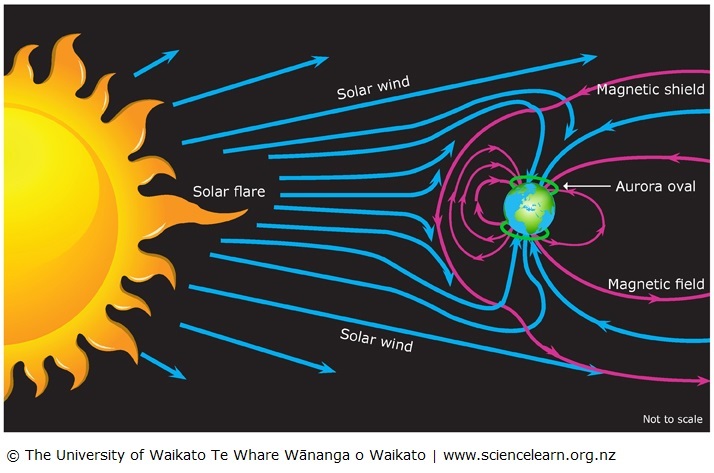
Impact of CMEs on Earth's Magnetosphere
-
Compression and Distortion of the Magnetosphere
When a Coronal Mass Ejection reaches Earth, it can have a profound impact on the magnetosphere. CMEs carry an intense magnetic field and a vast amount of charged particles. As a CME approaches, it compresses the magnetosphere on the day side of Earth, causing it to shrink and distort.
This compression can lead to magnetic reconnection events within the magnetosphere, releasing energy and charged particles into Earth's magnetosphere. This can result in the acceleration of charged particles, producing intense radiation belts and triggering geomagnetic storms.
-
Solar Storms and Geomagnetic Disturbances
One of the most noticeable effects of CMEs on Earth is the occurrence of solar storms and geomagnetic disturbances. When a CME interacts with Earth's magnetosphere, it can lead to the injection of high-energy particles into the magnetosphere and the ionosphere. These particles can create spectacular auroras when they collide with gas molecules in the Earth's upper atmosphere.
Additionally, the disturbance of Earth's magnetic field by CMEs can have significant technological implications. Geomagnetic storms can disrupt power grids, GPS systems, and communication networks. They can also pose risks to astronauts in space and affect the operation of satellites.
In summary, the interaction between CMEs and Earth's magnetosphere is a complex dance of magnetic fields and charged particles. This interaction can lead to the mesmerizing auroras seen in the polar regions but also has the potential to disrupt technological systems on Earth. Understanding these interactions is essential for both space weather forecasting and safeguarding our technological infrastructure.
The Aurora Connection: How CMEs Influence Auroras
A. The Role of Charged Particles in Aurora Formation
Auroras, both in the Northern Hemisphere (Aurora Borealis) and the Southern Hemisphere (Aurora Australis), are captivating natural light displays in the Earth's polar regions. They are primarily caused by the interaction of charged particles with gases in the Earth's atmosphere. Understanding the role of charged particles in aurora formation is fundamental to comprehending how Coronal Mass Ejections (CMEs) influence these breathtaking celestial phenomena.
B. Injection of Charged Particles by CMEs
When a CME from the Sun reaches Earth, it carries with it a massive influx of charged particles, predominantly electrons and protons. These charged particles are funneled toward the Earth's polar regions by the planet's magnetic field.
As these high-energy particles collide with gases, primarily oxygen and nitrogen, in the Earth's upper atmosphere, they transfer their energy to these atoms and molecules. This energy is then released in the form of light, creating the stunning and colorful displays that we associate with auroras.
C. The Auroral Oval and Its Expansion During CME Events
Earth's magnetic field funnels the charged particles from CMEs toward the polar regions, where the auroras are typically observed. The auroras occur within an oval-shaped region around each of the Earth's poles, known as the auroral oval.
During periods of heightened solar activity, such as when a CME arrives at Earth, the auroral oval can expand further from the poles. This expansion increases the geographic range where auroras are visible. Consequently, during CME-induced geomagnetic storms, auroras may be observed at latitudes much lower than their usual polar locations. This phenomenon allows people at more moderate latitudes to witness these captivating light displays.
D. Colors and Intensities of Auroras During CME-Induced Storms
The colors and intensities of auroras are influenced by several factors, including the type of gas molecules present in the Earth's atmosphere and the altitude at which the charged particles collide with these molecules.
Oxygen molecules at higher altitudes can produce red and green auroras. Helium and hydrogen molecules typically produce blue and purplish-colours. The specific colours and their intensities during an aurora display are determined by the energy levels of the colliding particles and the gases they interact with.
During CME-induced geomagnetic storms, the increased influx of charged particles results in more intense and widespread auroral displays. This means that observers at lower latitudes are more likely to witness vivid and colorful auroras, sometimes even outside the usual polar regions.
In summary, the injection of charged particles by Coronal Mass Ejections into the Earth's magnetosphere plays a crucial role in enhancing the beauty and geographic range of auroras. These natural light shows, which result from the interaction of charged particles with the Earth's atmosphere, can become even more spectacular and visible at lower latitudes during CME-induced geomagnetic storms.
Observing CME-Induced Auroras
A. Best Times and Locations to Witness CME-Induced Auroras
- Geographic Location: To witness CME-induced auroras, being in the right geographic location is crucial. Generally, the closer you are to the Earth's polar regions, the more frequently you'll have the opportunity to observe auroras. This includes regions such as Alaska, northern Canada, Scandinavia, and Antarctica. However, during strong CME events, auroras can be visible at lower latitudes, increasing the chances for people in mid-latitudes to see them.
- Clear, Dark Skies: Light pollution from cities can significantly diminish the visibility of auroras. Therefore, the best locations for aurora viewing are remote areas with minimal light pollution. National parks, wilderness areas, and rural regions far from urban centers are ideal.
- Winter Months: While auroras can occur year-round, they are more commonly observed during the winter months when nights are longer and darker. In polar regions, where nights can be exceptionally long, winter is the peak aurora season.
B. Personal Experiences of Aurora Chasers During CME Events
- Community of Aurora Enthusiasts: There is many global and local communities of aurora enthusiasts and amateur astronomers who actively chase auroras during CME-induced events. Engaging with this community can provide valuable insights, tips, and even collaborative opportunities for capturing stunning aurora photographs.
- Preparation and Patience: Aurora chasing often requires patience and preparation. Aurora enthusiasts often monitor forecasts, plan trips to dark-sky locations, and wait for hours in the cold to capture the perfect shot. Many share their experiences, including the challenges and rewards, through blogs, social media, and photography forums.
- Photography Techniques: Capturing the beauty of auroras in photographs can be an art in itself. Aurora chasers often share their photography techniques, camera settings, and post-processing tips to help others capture the magic of CME-induced auroras.
In summary, witnessing CME-induced auroras is a remarkable experience that combines science, nature, and photography. To make the most of these awe-inspiring displays, it's essential to be in the right location, stay informed through space weather alerts, and learn from the experiences of seasoned aurora chasers. With the right tools, resources, and a bit of patience, you can increase your chances of observing and capturing the mesmerizing beauty of CME-induced auroras.
Impacts Beyond Auroras
A. Space Weather and Its Effects on Technology
- Space Weather Overview: Space weather refers to the conditions on the Sun and in the solar wind, magnetosphere, ionosphere, and thermosphere that can influence the performance and reliability of space-borne and ground-based technological systems. It encompasses various solar phenomena, including CMEs.
- Ionospheric Disturbances: CMEs can significantly disturb the Earth's ionosphere, which affects radio wave propagation. Radio signals, especially those in the high-frequency range, may experience attenuation or disruptions during geomagnetic storms induced by CMEs. This can impact communication systems, including aviation and maritime communication.
- GPS and Navigation: The Global Positioning System (GPS) relies on signals transmitted from satellites to determine precise locations on Earth. During geomagnetic storms caused by CMEs, the ionosphere's disturbances can lead to GPS signal degradation or even loss of accuracy. This can affect navigation systems used in aviation, maritime, and land-based applications.
B. Satellite Disruptions and Power Grid Concerns
- Satellite Vulnerability: Satellites orbiting the Earth are vulnerable to the effects of CMEs. The increased radiation and charged particles can cause electronic components to malfunction or degrade over time. Space agencies and satellite operators take measures to protect and mitigate potential damage during solar storms.
- Power Grid Vulnerability: Geomagnetic storms triggered by CMEs can induce electric currents in power transmission lines and transformers on Earth. These geomagnetic-induced currents (GICs) can disrupt power grids, leading to voltage instability and potential equipment damage. In severe cases, large-scale power outages can occur, affecting homes, businesses, and critical infrastructure.
- Preventative Measures: To safeguard critical infrastructure, power grid operators closely monitor space weather forecasts. When a significant CME event is predicted, power grid operators may take preventive actions, such as adjusting grid configurations and limiting power transfer to reduce the impact of GICs.
C. Research and Monitoring Efforts to Predict CMEs and Their Impacts
- Solar Observatories: Solar observatories like the Solar and Heliospheric Observatory (SOHO) and the Solar Dynamics Observatory (SDO) continuously monitor the Sun's activity, including the formation and ejection of CMEs. These observatories provide valuable data for space weather forecasting and early warning systems.
- Space Weather Prediction Centers: Space agencies and organizations worldwide operate space weather prediction centers. These centers use data from solar observatories, satellites, and ground-based sensors to monitor and forecast space weather events, including CMEs. They issue alerts and warnings to mitigate potential impacts on technology and infrastructure.
- International Collaboration: Space weather is a global concern, and international collaboration is essential for accurate prediction and mitigation efforts. Space agencies, research institutions, and governments worldwide share data and collaborate on research projects aimed at better understanding CMEs and improving space weather forecasting.
In conclusion, the impacts of CMEs extend beyond the spectacular auroras they produce. These solar events can disrupt technology, satellite operations, and power grids, potentially affecting communication, navigation, and energy distribution. To mitigate these impacts, ongoing research, monitoring, and international cooperation are essential in predicting CMEs and their potential consequences on Earth's technological infrastructure.
Conclusion
A. Recap of Key Points
- Understanding CMEs: Coronal Mass Ejections (CMEs) are massive bursts of solar wind and magnetic fields rising above the solar corona or being released into space. They are a result of complex interactions in the Sun's magnetic field and can have significant effects on Earth.
- Formation of CMEs: CMEs are formed through processes like magnetic reconnection, which involves the release of magnetic energy stored in the Sun's atmosphere. These events are closely linked to solar flares and eruptions.
- Interaction with Earth: When CMEs reach Earth, they interact with our planet's magnetosphere, often causing geomagnetic storms. These storms can lead to beautiful auroras, but they also have practical implications for technology and infrastructure.
- Observing Auroras: CME-induced auroras are a mesmerizing natural phenomenon visible in regions near the polar circles. Their colors and intensities vary depending on factors like solar wind speed and the Earth's magnetic field.
- Impacts Beyond Auroras: CMEs can disrupt technology, affecting communication systems, navigation, and even power grids. Preventative measures and ongoing research are essential to mitigate these impacts.
B. The Ongoing Fascination and Scientific Importance of CMEs and Auroras
- Scientific Curiosity: CMEs and auroras have captivated human curiosity for centuries. Their beauty and grandeur continue to inspire both amateur and professional astronomers. Scientists are driven to understand the underlying mechanisms of these phenomena.
- Advancing Space Weather Science: Studying CMEs and their interactions with Earth's magnetosphere is crucial for advancing space weather science. This field not only enhances our understanding of the Sun-Earth connection but also helps protect technology and infrastructure from space weather-related disruptions.
- Space Exploration: Knowledge about space weather, including the behavior of CMEs, is critical for space exploration and the safety of astronauts. Understanding how CMEs affect the space environment is essential for planning missions beyond Earth's orbit.
C. The Need for Continued Research and Monitoring of Space Weather
- Space Weather Predictions: As our reliance on technology in daily life continues to grow, accurate space weather predictions become increasingly important. Continued research and monitoring efforts are necessary to provide timely warnings and mitigate the impact of space weather events on Earth.
- Global Collaboration: Space weather is a global concern that requires international collaboration. Governments, space agencies, and research institutions from around the world work together to share data, develop forecasting models, and improve our ability to predict and respond to space weather events.
- Scientific Discovery: Research into CMEs and auroras not only has practical applications but also contributes to our understanding of the broader universe. These phenomena offer valuable insights into the behavior of stars, magnetic fields, and plasma physics, leading to discoveries that extend beyond our solar system.
In conclusion, CMEs and the auroras they produce are not only a source of wonder and beauty but also subjects of significant scientific interest and practical importance. Ongoing research, international collaboration, and improved space weather forecasting are essential to harness the benefits of this knowledge while safeguarding our technology and infrastructure from the impacts of space weather events. As our understanding of CMEs and auroras deepens, we continue to unlock the mysteries of our dynamic solar system and the broader cosmos.